What are the most popular forms of transport from Turkey to Poland?
Every type of transport has its advantages, costs and limitations. What works for light loads is not necessarily the best option for oversized goods.
1. Road transport – the most common choice
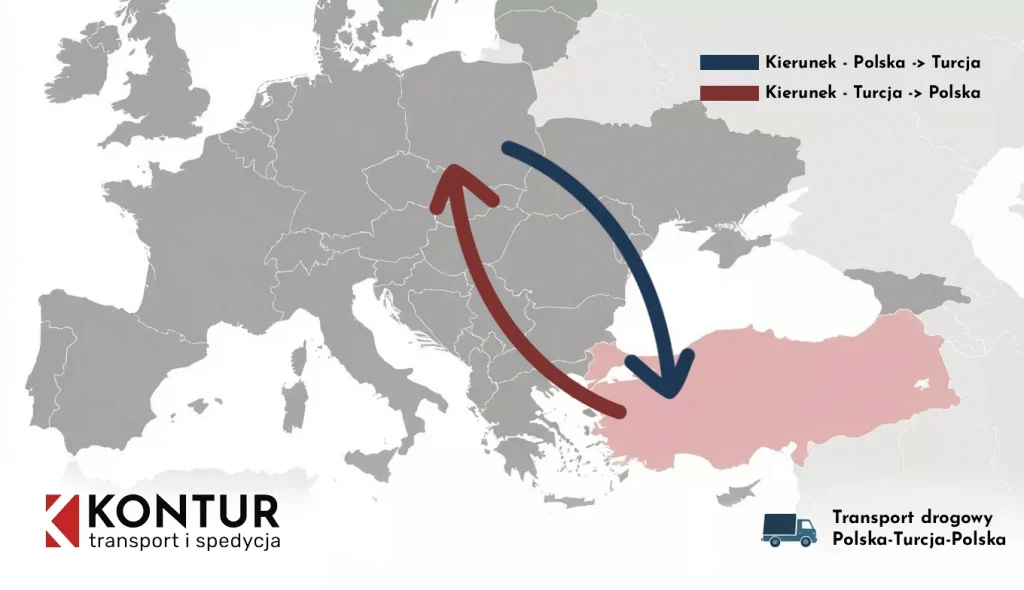
Road transport on the Turkey–Poland route is chosen most often, because it combines fast delivery with great flexibility in organising the carriage.
- the fastest and most dominant mode for imports from Turkey,
- delivery usually in 5-10 days,
- high flexibility (various types of load),
- works for both regular and one-off deliveries.
Do you want your goods carried on time and safely? Work with Kontur Polska – we provide a complete road transport service for transport Turkey.
Key elements of road transport
- FTL – full-truckload transport, fast and without transhipment,
- LTL – groupage, lower cost for smaller loads,
- regular lines – e.g. express groupage services,
- a well-developed motorway network in Turkey,
- HGS – electronic toll collection system (no paper vignettes),
- constant vehicle monitoring and the possibility of door-to-door delivery.
Customs documents in road transport
- EX-1 – export declaration,
- A.TR – preferential document under the Customs Union (reduces or eliminates duty on industrial goods),
- commercial invoice,
- packing list,
- CMR consignment note.
2. Sea transport
For larger consignments, companies readily turn to sea transport, because it significantly reduces the cost per unit of cargo, although it considerably increases delivery time.
- cost-effective for large quantities of goods,
- options available: FCL (full container) and LCL (groupage),
- often used in the sea-road model,
- possibility of using consolidation warehouses in Turkey,
- longer delivery time (approx. 20-35 days).
3. Air transport
Air transport becomes the best choice when delivery time is the key element of the whole process, regardless of cost.
- a fast form of transport (1-3 days),
- the most expensive form of transport – usually several times more than road transport,
- used for urgent or high-value goods.
Import and export to Turkey – what are the most popular transport methods?
Import and export with Turkey involve various forms of carriage, chosen primarily according to the specifics of the goods.
- Road transport (LTL/FTL): regular groupage and full-truckload lines, fleet up to 120 m³ and 24 tonnes.
- ADR transport: carriage of dangerous goods with temperature control and full regulatory compliance.
- Refrigerated transport: ATP vehicles, route monitoring, temperature printouts, support during loading/unloading.
- Abnormal transport: road permits, bridge surveys, escort vehicles, infrastructure works.
- Multimodal transport: combining several means of transport (road + air, sea or rail).
What are the key aspects of Turkey–Poland trade?
- EU-Turkey Customs Union
Turkey participates in a customs union with the European Union (excluding agricultural products and steel). As a result, most industrial goods can be imported into Poland without full customs rates, provided the supplier issues an A.TR document. - Preferential customs terms
The A.TR document confirms that industrial goods originate from the customs territory of Turkey and can benefit from preferences. In practice this means lower import costs and faster clearance. - Growing two-way trade
Trade between Poland and Turkey is growing dynamically. Turkey is one of the EU’s most important economic partners in the region. - Main imports from Turkey to Poland
- textiles and clothing,
- machinery and components,
- agricultural produce (vegetables, fruit),
- plastic products.
- Main exports from Poland to Turkey
- machinery and equipment,
- industrial chemical products,
- electronics and electrical goods,
- food products.
- Stable and predictable deliveries
Well-developed road infrastructure, regular transport lines and extensive logistics cooperation make transport on the Poland–Turkey route stable and predictable.
International transport Turkey – what are the current regulations and customs requirements?
The customs requirements for transport from Turkey stem mainly from the rules of the EU-Turkey customs union, which allows favourable treatment of most industrial goods.
- EU-Turkey Customs Union: covers most industrial goods; allows customs preferences to be used.
- A.TR document: confirms the customs status of the goods and allows duty to be reduced or eliminated on import.
- EX-1 document: required for export from Turkey as the export declaration.
- Invoice and packing list: mandatory documents for every load.
- Consignment note: CMR (road), B/L (sea) or AWB (air).
- HS tariff codes: necessary for the correct calculation of duty and VAT.
- Customs clearance on both sides: export clearance in Turkey and import clearance in Poland are required.
- INTRASTAT declarations: required once statistical thresholds are exceeded.
- Border checks: possible, particularly for regulated goods (food, chemicals, ADR).
- HGS system: electronic tolls in force on Turkish motorways.
Formalities and documentation required for import
- EX-1 (export from Turkey),
- A.TR (customs preferences for industrial goods),
- commercial invoice and packing list,
- consignment note: CMR / B/L / AWB,
- HS tariff classification,
- customs declaration in Poland,
- optional: cargo insurance.
Forwarding companies usually help prepare all the documentation.
The transport process – stages, processes and organisational activities
The transport process is a set of activities that allow goods to be moved efficiently from the sender to the recipient. It covers the planning, execution and control of the entire operation.
Main stages of the transport process:
- Transport planning: choosing the means of transport, route and schedule, and checking documents.
- Preparing the goods: packing, labelling, securing the load and preparing documentation.
- Loading and the journey: correct positioning of the goods, transport according to schedule, route monitoring.
- Unloading: safe removal of the load and handover to the recipient.
- After-delivery handling: confirmation of receipt, finalising documents and handling any returns.
Key organisational processes:
- organising a suitable fleet and drivers,
- choosing the optimal route and means of transport,
- coordinating loading and unloading,
- handling during customs clearance,
- quality control and monitoring of on-time performance.
The most important activities:
- preparing transport documents,
- ensuring the load is properly secured,
- communication between sender, carrier and recipient,
- monitoring the progress of the transport.
What are the main advantages of road transport from Turkey to Poland?
- Fast delivery time: road transport gets from Turkey to Poland in just 5-10 days.
- Flexible transport options: FTL, LTL and express lines available.
- Efficient infrastructure: motorways and the HGS system make journeys easier.
- Lower customs costs: the A.TR document allows preferential rates.
- Flexibility: the option of working door-to-door or hub-to-hub,
- Forwarding support: help with EX-1, A.TR, clearance and monitoring.
- Regular routes: stable connections ensure predictability.
The most common mistakes in transport from Turkey and how to avoid them
- No A.TR document: results in full duty being charged.
How to avoid it? Always make sure the supplier issues an A.TR for industrial goods. - Wrong HS code: leads to clearance errors or additional costs.
How to avoid it? Verify the tariff classification before shipping. - Wrong type of transport: e.g. LTL for goods that need full protection.
How to avoid it? Match the transport to the dimensions, value and deadline. - Underestimating delivery time: especially with sea transport.
How to avoid it? Plan with a margin of 7-10 days. - No cargo insurance: financial risk in the event of damage or loss.
How to avoid it? Always take out insurance, especially for expensive loads. - Handling clearance yourself without experience: can extend the process by several days.
How to avoid it? Use a customs agency or a forwarder with experience in Turkey.
Transport Turkey – warehousing services
Both transport and import from Turkey often require suitable warehousing facilities to keep operations running smoothly and goods secure. Kontur Polska offers comprehensive warehousing services supporting the entire logistics process – from receipt of the shipment to its distribution.
- Receipt and handling of goods: quality, quantity and document checks.
- Secure storage: modern warehouse space adapted to different types of load.
- Transhipment and cross-docking: fast operations that shorten delivery times.
- Picking and packing: preparing goods in line with the recipient’s requirements.
- Domestic and international distribution: full logistics support for goods imported from Turkey.
- Continuous stock control: up-to-date information and predictable inventory management.
Types of warehouses – functions, classification and their tasks
Warehouses play a key role in the supply chain, ensuring the safe storage of goods and efficient logistics handling. They differ in construction, purpose and scope of operations.
Functions of warehouses:
- storage and protection of goods,
- order picking,
- transhipment and transport handling,
- stock and turnover control.
Types of warehouses:
- open warehouses,
- semi-open,
- closed,
- specialised (e.g. cold stores, ADR, high-bay).
The most important tasks of warehouses:
- maintaining continuity of supply,
- supporting transport and distribution processes,
- ensuring optimal storage conditions,
- streamlining inventory management.
Logistics summary
- Road transport: the most common choice thanks to its speed and flexibility.
- Customs Union: simplifies trade between Turkey and the EU and reduces costs.
- EX-1 and A.TR: key documents for clearance and preferential customs rates.
- Forwarding support: an experienced company minimises errors and streamlines the whole process.
Why choose road transport from Turkey with Kontur Polska?
In practice, road transport proves to be the most advantageous solution on the Turkey–Poland route. It combines fast delivery with a flexibility that no other method of carriage offers – goods can be collected directly from the manufacturer and delivered to any address without transhipment along the way.
Do you value efficient organisation, reliable dates and full support with customs documentation? Choose Kontur Polska. For years we have run regular road transport to and from Turkey, providing fixed lines, cargo monitoring and professional forwarding care at every stage of transport.
FAQ – frequently asked questions about transport from Turkey to Poland
- How long does transport from Turkey to Poland take?
Usually 5-10 days by road. Sea transport takes approx. 20-35 days, and air 1-3 days. - Is road transport from Turkey cost-effective?
Yes. For standard loads and regular deliveries, road transport is the fastest, most flexible and often cheaper than air or sea over shorter distances. - Is Turkey in a Customs Union with the EU?
Yes, with the exception of agricultural products and steel. As a result, most industrial goods can benefit from preferential customs rates on the basis of an A.TR document.
Do I need a customs agency to import from Turkey?
It is not mandatory, but most companies use an agency, because it significantly speeds up clearance and reduces the risk of errors.